
Parkinson’s disease affects movement in ways that make choosing the right walking aid especially important. Freezing of gait, tremor, rigidity and balance difficulties all demand specific consideration that standard walking aids may not account for.
At A6 Mobility Shop, we’ve helped people across Stockport, Manchester and Cheshire find walking aids suited to their individual mobility challenges for over 30 years. Our team has care, medical and mobility equipment experience, so the advice you receive is based on your actual needs. If you or a loved one is living with Parkinson’s, we can help you find a walking aid that supports safer, more confident movement.
The right choice depends on your current symptoms, your strength and where you’ll use it most.
Walking sticks provide light support for people in earlier stages who need extra stability. Height-adjustable models are generally more practical than fixed-height ones, since posture can change as symptoms fluctuate. Folding walking sticks are convenient to keep on each level of your home or carry in a bag.
If tremor or rigidity affects your hands, a walking stick with an ergonomic handle can be easier to grip. It’s worth noting that quad canes, while offering a wider base, don’t always suit Parkinson’s well — they can be heavier and harder to move in time with your stride.
Walking frames offer four-point support and greater stability, working well indoors where distances are short and surfaces are flat. However, non-wheeled frames require you to lift the device with each step, and this stop-start movement doesn’t always suit Parkinson’s. Lifting and placing a frame can disrupt walking rhythm and may increase the likelihood of freezing.
For this reason, many physiotherapists recommend wheeled walking aids for people with Parkinson’s rather than standard lift-and-place frames. Folding frames can still be useful at home for specific situations, such as getting up from a chair.
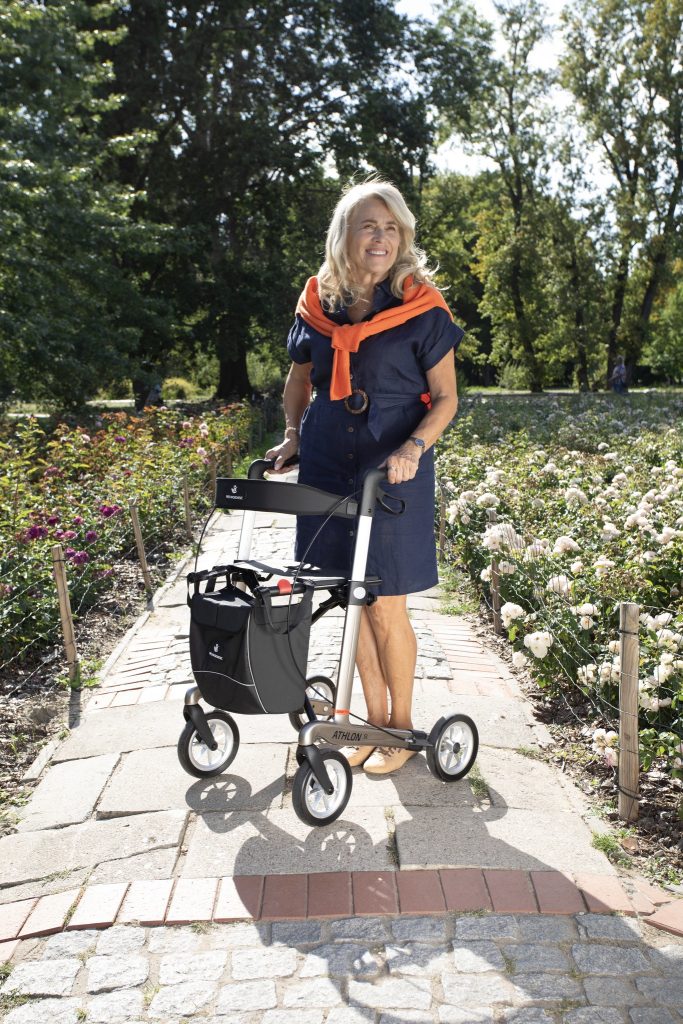
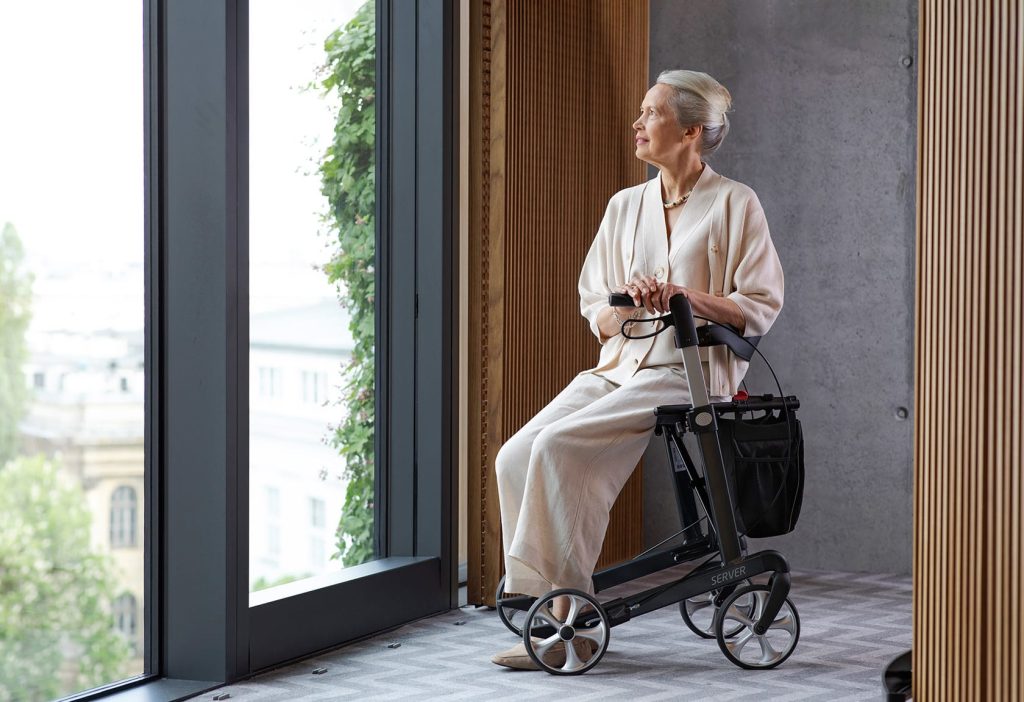
Rollators are often the most practical everyday walking aid for people with Parkinson’s. Because they roll continuously, they encourage smoother, more natural movement without the stop-start motion of a standard frame.
Four-wheeled rollators typically include a built-in seat for resting, hand brakes and a storage basket. Three-wheeled rollators are lighter and more manoeuvrable in tight spaces but are generally less stable and don’t usually include a seat.
Loop-style brakes are typically easier to operate for people with hand rigidity or reduced grip strength. The weight of the rollator matters too – a heavier frame provides more stability but can be harder to transport, while a lightweight model is easier to lift into a car but may feel less secure.
Some people with Parkinson’s don’t need a wheelchair every day but find one invaluable on more difficult days or for longer outings. A lightweight wheelchair can extend your world considerably, allowing you to conserve energy for the activities that matter most.
Self-propelled wheelchairs give you the option to move independently when you have the energy and be pushed by a companion when you don’t. Powerchairs offer powered mobility for those who need more consistent support. We stock over a wide range of wheelchairs and powerchairs in our Stockport showroom, including models from Pride Mobility, Quantum and Monarch.
Parkinson’s creates movement challenges that can change from day to day and even hour to hour.
Freezing of gait (where your feet feel glued to the floor) is one of the most common symptoms, often happening when starting to walk, turning or passing through doorways.
Balance and postural instability increase the risk of falls, particularly as the condition progresses. Tremor and rigidity in the hands and arms can make gripping handles or operating brakes more difficult, meaning ergonomic design and ease of use matter enormously.
Festination, where steps become involuntarily short and rapid, is another concern that the right walking aid can help manage.a
Excellent value — we’ll gladly match or beat any genuine quote from another mobility retailer
Brand new, ex-display and professionally refurbished rollator walkers ready to take home
Free local demonstrations, fitting and home delivery on selected rollators across Manchester
Our engineers can usually arrange servicing, adjustments and warranty assistance within 3 working days
Family-run mobility specialists helping customers choose quality rollators since 1992
Your current symptoms should guide the level of support you need. Someone experiencing occasional unsteadiness may do well with a walking stick, while frequent freezing or falls may call for a rollator or a wheelchair for longer distances.
Where you’ll use the aid matters too. Indoor aids need to fit through doorways and turn in smaller spaces, while outdoor use demands larger wheels and possibly a built-in seat. Many people benefit from having more than one walking aid.
Your hand strength and dexterity determine which handles and brakes will work. Parkinson’s can also vary throughout the day, so a versatile device that adapts to changing needs often offers the most value. The best approach is to try different walking aids in person before committing.
Find the Right Walking Aid For Parkinson's in Stockport
Visit our showroom to try different walking aids in person, or call us on 0161 429 6000 for friendly, practical advice. No pressure, no obligation — just support from a local family business that’s been helping people stay mobile and independent for over three decades.
No. Anyone experiencing difficulty with balance or movement can visit our showroom. If you’re working with a physiotherapist or occupational therapist, their recommendations can help guide the decision.
For most people with Parkinson’s, a rollator is generally more suitable. Rollators allow continuous movement that supports a natural walking rhythm, whereas lifting a standard frame can disrupt gait and potentially worsen freezing. Our team can help you work out which type is the best fit.
Yes, and we’d encourage it. Our showroom has walking sticks, frames, rollators and wheelchairs available to try. For Parkinson’s, testing in person is especially important so you can assess grip, brakes and comfort.
We do. Our qualified in-house engineers carry out adjustments, maintenance and repairs, with most call-outs attended within just two working days.